
The promise
What hope asks us to build.
Caitlin Moran’s argument for getting offline names the emotional outcome KIN must protect: faith in other people, restored through ordinary acts of participation.
Caitlin Moran remembers when social media felt like proof that people could be funny, generous, and collectively useful. Then she traces what happened when a tool for finding one another became a machine for escalation, public judgment, and permanent alert.
Her essay is not simply an argument for nostalgia. It is a diagnosis of scale. When context disappears and intensity is rewarded, people stop appearing as complicated human beings. They become positions, causes, enemies, audiences, and metrics.
Hope returns at human scale.
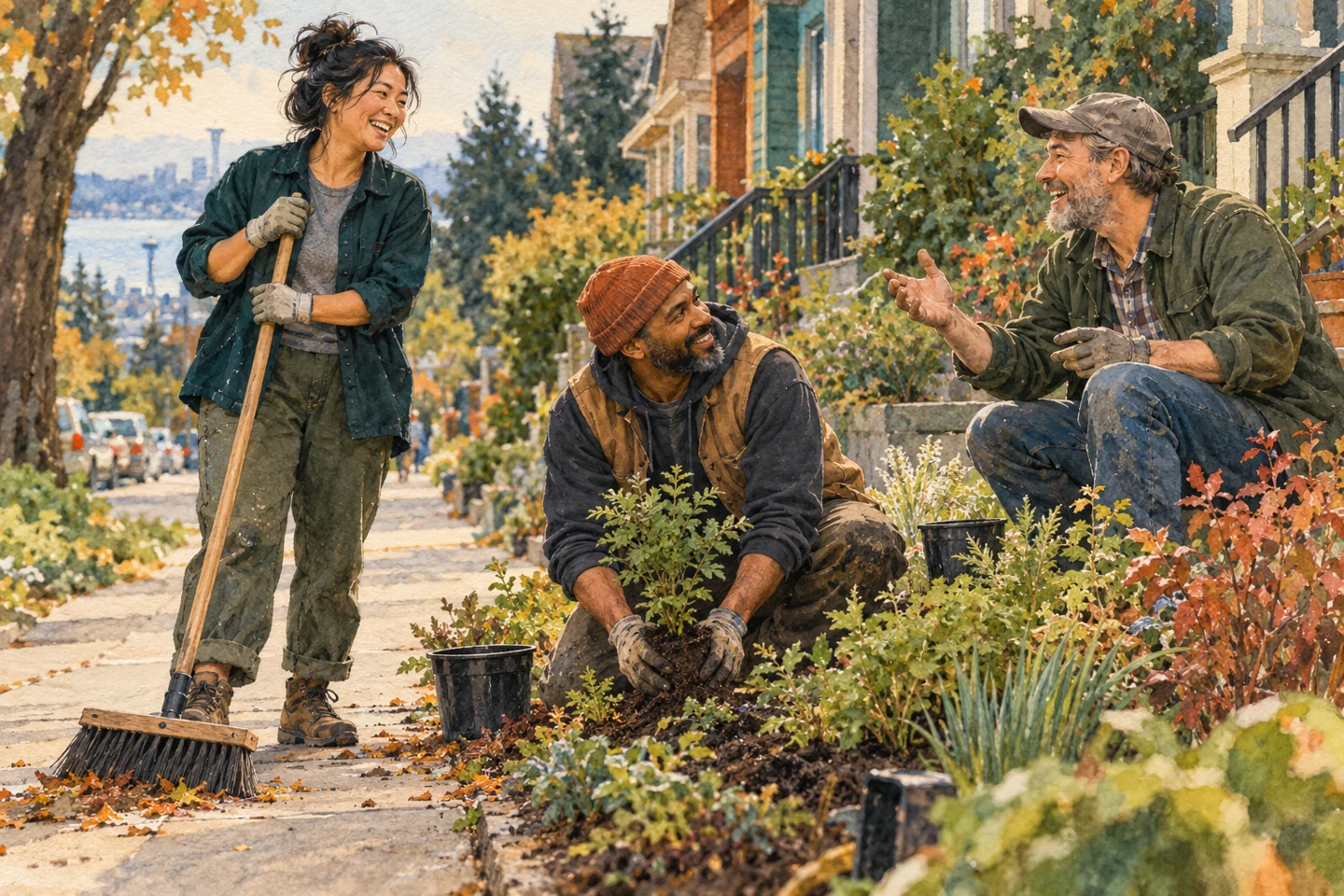
Moran’s way back is strikingly ordinary: pick up litter, donate blood, tend a garden, listen to the people on the bus, help someone nearby, and spend less time inside the machinery that insists the world is only getting worse.
These are not grand declarations. They are small encounters with consequence. You do something. Another person benefits. A place becomes more alive. The world answers back.
The opposite of doomscrolling is not optimism. It is participation.
That is the idea KIN must carry into the product.
This is the job KIN is accepting.
KIN cannot become another feed about belonging. If it succeeds, the value begins when the phone goes back into a pocket and two people enter the same room.
The product should help someone find a person with whom a real plan feels possible. Then it should support the small sequence through which strangers become part of one another’s lives: find each other, make a plan, show up, and do it again.
That sequence is not dramatic. It is how trust accumulates.
Shared Ground is a way to look again.
Every KIN profile begins with what two people hold in common. Not because difference should be hidden, and not because sameness is the price of friendship. Shared Ground is a deliberate interruption of the habit of seeing threat before humanity.
A profile cannot prove that someone is good. It can create one honest reason to remain curious long enough to find out.
What this asks of KIN
- Do not build an infinite feed. Discovery should lead toward a decision, not an endless supply of alternatives.
- Measure plans made, meetings kept, and the desire to meet again. Time inside the app is not the outcome.
- Make the Show Up Loop visible: find each other, make a plan, show up, do it again.
- Use Shared Ground to invite curiosity across difference, never to manufacture ideological rooms.
- Design KIN to become less necessary as a friendship becomes more real.
Hope must not become naïveté.
Believing that most people are good does not require pretending that everyone is safe. KIN still needs careful reporting, clear boundaries, graceful ways to decline, and consequences for people who misuse trust.
Hope is not the absence of discernment. It is the refusal to let the worst behavior become the only story we tell about one another.
What we still do not know.
Can a digital product restore faith in people without asking users to spend more of their lives inside it? Can we design for the messy middle between introduction and belonging, where interest must become initiative and initiative must become repetition?
We do not yet know. But Moran’s essay clarifies the test: KIN should leave people with more evidence that other human beings are reachable, complicated, and worth showing up for.
Build for the moment the phone can go back in the pocket.